
Trimethoprim Hyperkalemia Risk Calculator
Risk Assessment
Results
Recommended action:
Trimethoprim may be considered with standard monitoring. Check potassium at 48-72 hours.
How to interpret:
- 0-1 points: Low risk
- 2-3 points: Moderate risk
- 4+ points: High risk
Trimethoprim is one of the most commonly prescribed antibiotics in the U.S., usually given as part of trimethoprim-sulfamethoxazole (brand names like Bactrim or Septra). It’s used for urinary tract infections, bronchitis, and even to prevent pneumonia in people with weakened immune systems. But behind its widespread use is a quiet, dangerous side effect that many doctors still overlook: hyperkalemia - dangerously high potassium levels in the blood.
Most people assume antibiotics only affect bacteria. But trimethoprim doesn’t work like typical antibiotics. It acts like a hidden diuretic, and not just any diuretic - one that keeps potassium in your body. This can cause potassium levels to spike in as little as 48 hours. A normal potassium level is between 3.5 and 5.0 mmol/L. When it climbs above 5.5, you’re in danger. Above 6.5, and your heart can stop.
How Trimethoprim Raises Potassium
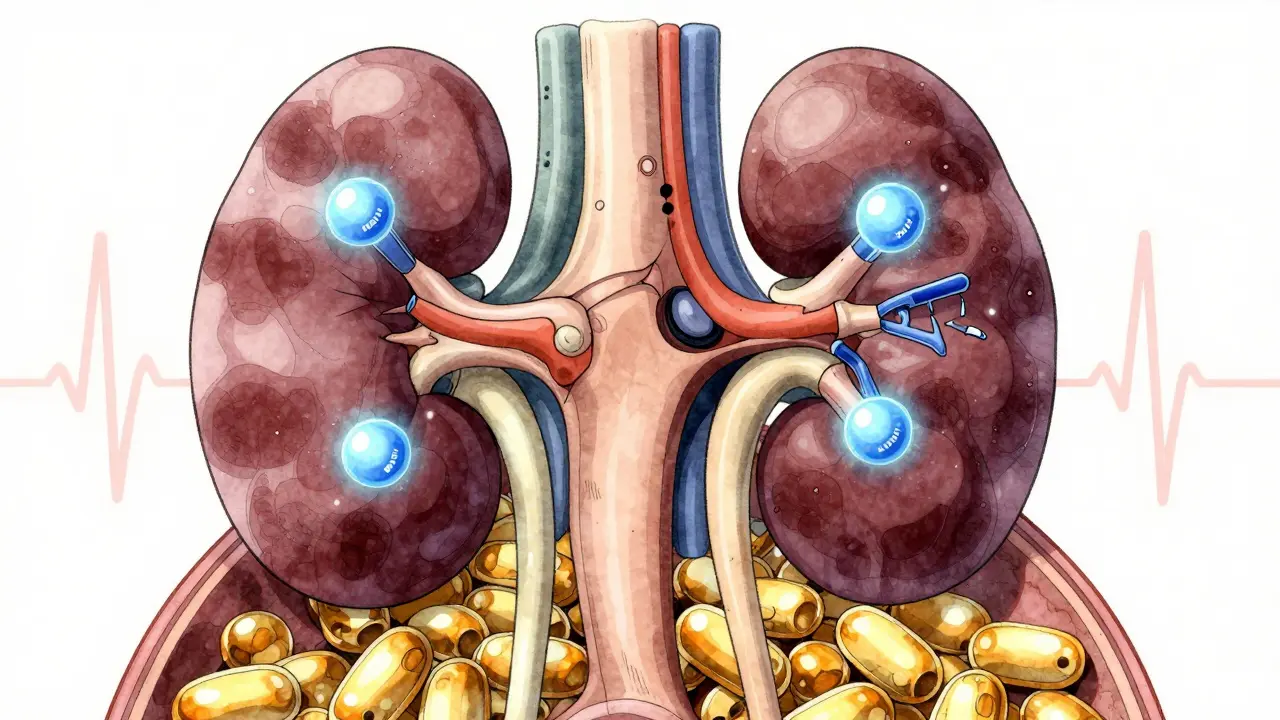
The reason trimethoprim causes hyperkalemia is surprisingly simple. It mimics a drug called amiloride, which is designed to block sodium reabsorption in the kidneys. By doing this, it reduces the electrical signal that pushes potassium out of the blood and into the urine. The result? Potassium builds up.
This isn’t a slow, gradual effect. In a 2012 case study, a patient’s potassium rose from 4.2 to 6.1 mmol/L in just 72 hours after starting a standard dose of Bactrim. Another case in 2023 involved an 80-year-old woman with no prior kidney problems. She was on a low-dose prophylactic regimen - the kind meant to be safe - and her potassium shot up to 7.8 mmol/L. She went into cardiac arrest. She survived, but barely.
The drug concentrates in the kidneys at levels 10 to 50 times higher than in the bloodstream. That’s why even small doses can have big effects. And because trimethoprim is cleared almost entirely by the kidneys, any decline in kidney function - even mild - makes the risk much worse.
Who’s at the Highest Risk?
Not everyone who takes trimethoprim will develop high potassium. But certain people are at extreme risk:
- Patients over 65
- Those with chronic kidney disease (eGFR below 60 mL/min)
- People taking ACE inhibitors (like lisinopril) or ARBs (like losartan)
- Diabetics with kidney damage
- Those already on potassium-sparing diuretics (like spironolactone)
A 2014 study in JAMA Internal Medicine followed over 4,000 hospitalizations for hyperkalemia. Among older adults on blood pressure meds like lisinopril, those who took Bactrim had a 6.7 times higher risk of being hospitalized for high potassium than those who took amoxicillin. That’s not a small increase - it’s a red flag.
And it gets worse. A 2020 analysis found that patients with diabetes, kidney disease, and on ACEIs/ARBs had a 32.1% chance of developing hyperkalemia from trimethoprim. Compare that to just 4.3% in similar patients taking other antibiotics. That’s a 7-fold difference.
Real-World Consequences
The FDA’s Adverse Event Reporting System recorded 1,247 cases of trimethoprim-induced hyperkalemia between 2010 and 2020. Of those, 43 people died. Over two-thirds of those deaths were in patients over 65. One Reddit thread from a physician in 2023 described a 72-year-old woman on lisinopril who developed a potassium level of 6.8 after three days of Bactrim. She needed emergency dialysis. Another doctor noted that in their practice, only 15% of similar patients had elevated potassium - but every single one improved after stopping the drug.
Most cases happen fast. A 2021 review of 37 severe cases found that 78% of patients reached potassium levels above 6.0 mmol/L within 72 hours. The average time to peak potassium was just 2.3 days. That’s why monitoring isn’t optional - it’s life-saving.
What Should Doctors Do?
Guidelines are clear, but practice isn’t. The American Geriatrics Society’s 2023 Beers Criteria says: Do not prescribe trimethoprim to adults over 65 who are on ACEIs or ARBs. The recommendation is labeled "strong" - meaning the evidence is solid and the risk is real.
The American Society of Health-System Pharmacists recommends:
- Check potassium before starting trimethoprim
- Repeat the test at 48 to 72 hours
- Stop the drug if potassium exceeds 5.5 mmol/L
- Avoid it entirely if baseline potassium is above 5.0 or eGFR is below 30
Yet, a 2023 survey found that only 41.7% of primary care doctors routinely check potassium before prescribing Bactrim. Emergency medicine doctors? Just 32.4%. Meanwhile, nephrologists - the kidney specialists - check it 89% of the time. There’s a huge gap between what’s known and what’s done.
Electronic alerts help. One study showed that when hospitals added mandatory potassium checks before prescribing trimethoprim to patients on blood pressure meds, hyperkalemia cases dropped by over half. That’s not just a statistic - it’s lives saved.
Alternatives to Trimethoprim
For urinary tract infections - the most common reason trimethoprim is prescribed - there are safer choices:
- Nitrofurantoin: No significant effect on potassium. Preferred for uncomplicated UTIs in older adults.
- Fosfomycin: Single-dose, low risk, effective for many UTIs.
- Cephalexin: A first-generation cephalosporin with minimal impact on electrolytes.
For patients who need trimethoprim for Pneumocystis pneumonia prophylaxis (common in HIV or transplant patients), the risk-benefit balance is different. In those cases, the drug may still be necessary. But even then, monitoring is non-negotiable. A 2019 review noted that with proper potassium checks, the benefits often outweigh the risks.

What Patients Should Know
If you’re prescribed Bactrim or Septra, especially if you’re over 65 or take blood pressure meds like lisinopril, losartan, or enalapril - ask these questions:
- "Have you checked my potassium level?"
- "Is there a safer antibiotic for my infection?"
- "Will you recheck my potassium in 3 days?"
Don’t assume your doctor already knows. Many don’t. If you feel weak, dizzy, or have an irregular heartbeat after starting the drug, get your potassium checked immediately. These symptoms can be silent until it’s too late.
And if you’ve been on trimethoprim for more than a week - even if you feel fine - ask for a repeat blood test. The danger doesn’t always show up right away.
The Bigger Picture
Trimethoprim-sulfamethoxazole is still used in over 14 million U.S. prescriptions each year. Nearly 3 million of those go to people over 65. That’s a lot of people at risk. The FDA added hyperkalemia to its boxed warning in 2019 - the strongest possible alert. But warnings alone don’t change practice.
Now, researchers are building tools to predict who’s most at risk. The TMP-HyperK Score, published in 2022, uses age, baseline potassium, kidney function, and whether the patient is on ACEIs or ARBs. It predicts hyperkalemia with nearly 90% accuracy. Hospitals that use it are already seeing fewer emergencies.
By 2026, the Institute for Healthcare Improvement estimates that if every hospital followed basic potassium-checking protocols, we could prevent 12,000 to 15,000 hospitalizations each year in the U.S. alone. That’s not just about avoiding side effects - it’s about preventing death.
Trimethoprim is not inherently bad. It’s effective. It’s cheap. It’s been used for decades. But it’s not harmless. It’s a drug that changes how your kidneys handle potassium - and that change can be deadly. The question isn’t whether you should use it. It’s whether you’re checking for the one thing that could save your life: your potassium level.
 Why a Multidisciplinary Approach Is Crucial for Poor Muscle Control
 Buy Cialis Professional Online: Your Guide to Secure Purchase
 Discover the Benefits of Coca: The Revolutionary Dietary Supplement
 Military Deployment and Medication Safety: How Heat, Storage, and Access Impact Soldier Health
 How to Check for Drug Interactions Before Starting New Medications: A Step-by-Step Guide
Nicole James
March 22, 2026 AT 00:54They say it's just an antibiotic... but what if it's a Trojan horse? The FDA knew. The pharmaceutical giants knew. They've been pushing this drug for decades because it's cheap, profitable, and people don't check their potassium-because no one tells them to. It's not negligence-it's design. They want you dependent. They want you sick enough to need dialysis, then another drug, then another. And who profits? The same ones who own the labs, the hospitals, the insurance companies. Wake up. This isn't medicine. It's a slow-motion extraction.
Nishan Basnet
March 22, 2026 AT 13:03This is one of the most important posts I've read in years. The way trimethoprim mimics amiloride is both elegant and terrifying-a biological mimicry that bypasses our body’s natural safeguards. I’ve seen patients in India with borderline kidney function prescribed Bactrim for a simple UTI, and no one thought to check electrolytes. We need global awareness, not just American guidelines. This isn't just a clinical issue-it's a moral one. We owe it to our patients to ask the hard questions before prescribing.
Bryan Woody
March 22, 2026 AT 15:53matthew runcie
March 24, 2026 AT 05:02Paul Cuccurullo
March 25, 2026 AT 15:35It is with profound gravity that I address this matter. The silent, systemic neglect of electrolyte monitoring in the face of a well-documented, high-risk pharmaceutical agent represents not merely an oversight, but a moral fissure within our modern healthcare paradigm. The data is irrefutable. The warnings are explicit. The human cost is measurable in cardiac arrests and dialysis units. To continue prescribing without intervention is not negligence-it is complicity. We must elevate vigilance to a sacred duty.
Solomon Kindie
March 26, 2026 AT 23:40trudale hampton
March 28, 2026 AT 18:54Shaun Wakashige
March 29, 2026 AT 01:31Sandy Wells
March 29, 2026 AT 09:33Timothy Olcott
March 30, 2026 AT 06:49Desiree LaPointe
March 30, 2026 AT 14:12Jackie Tucker
March 31, 2026 AT 14:15Thomas Jensen
March 31, 2026 AT 19:20