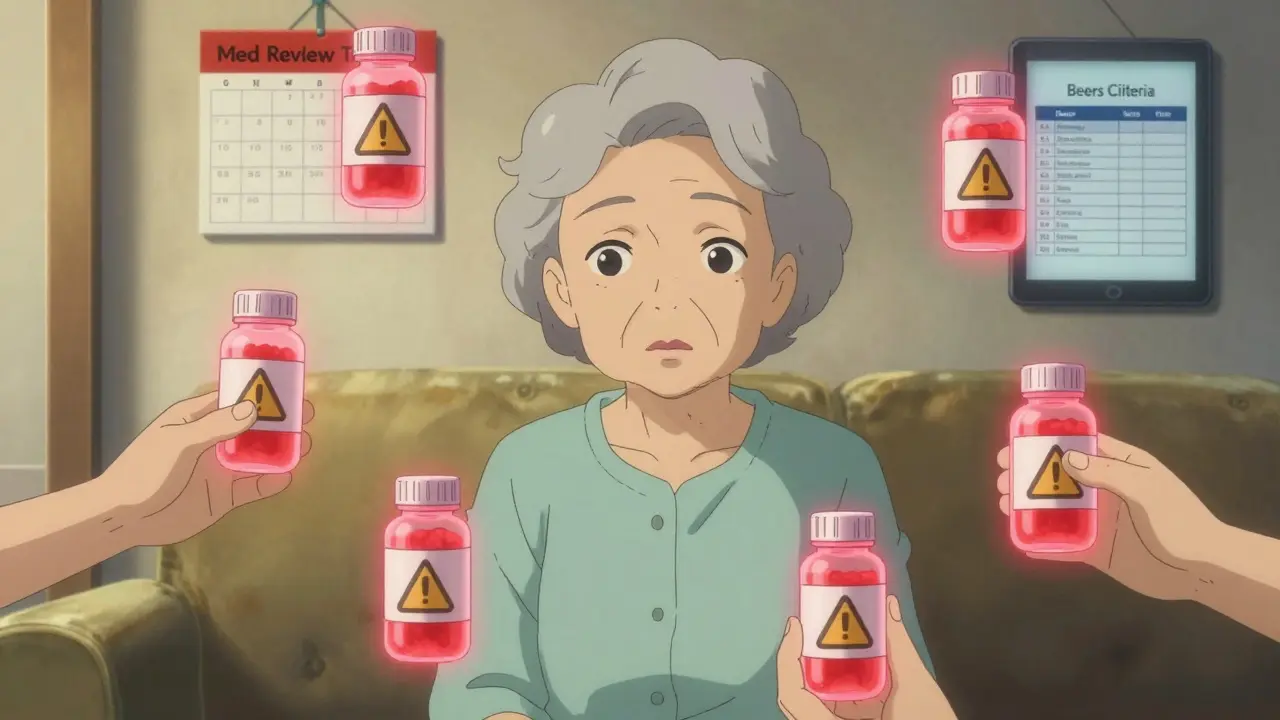
Every year, thousands of older adults end up in the hospital not because of a new illness, but because of a medication they were told to take. It’s not always a mistake - sometimes, it’s just that the drug was never meant for someone their age. That’s where the Beers Criteria come in. These aren’t rules carved in stone, but a practical guide used by doctors, pharmacists, and caregivers to spot drugs that do more harm than good in people 65 and older.
What Exactly Are the Beers Criteria?
The Beers Criteria are a list of medications that experts agree should be avoided or used with extreme caution in older adults. Developed by Dr. Mark Beers in 1991 and now updated every few years by the American Geriatrics Society (AGS), the latest version came out in 2023. It’s not a blacklist. It’s a warning system.Why does this even matter? As we age, our bodies change. Our kidneys don’t filter as well. Our liver slows down. Our brains become more sensitive to certain chemicals. A drug that’s fine for a 40-year-old might send an 80-year-old into a fall, confusion, or even a stroke. The Beers Criteria help cut through the noise by identifying drugs that carry higher risks than benefits in this group.
The 2023 update includes 131 specific medication warnings. That’s up from 97 in 2019. The list is broken into five clear sections:
- Drugs to avoid in almost all older adults
- Drugs to avoid if you have certain conditions like dementia, prostate issues, or heart failure
- Drugs that need extra caution - they’re not always dangerous, but they require close monitoring
- Drugs that become risky when kidney function drops
- Drug combinations that can cause dangerous interactions
For example, the list now strongly warns against using antipsychotics like haloperidol or risperidone in people with dementia - even if they’re agitated. These drugs don’t fix the dementia. They just suppress behavior, and they increase the risk of stroke and death. Benzodiazepines like diazepam (Valium) and lorazepam (Ativan) are also flagged for the same reason: they cause dizziness, falls, and memory problems. Even over-the-counter sleep aids with diphenhydramine (like Benadryl or Tylenol PM) are on the list. They’re cheap, easy to get, and often prescribed without thinking - but they’re not safe for long-term use in older adults.
Why Do These Drugs Keep Getting Prescribed?
It’s not because doctors are careless. It’s because the system is messy.Many older adults see multiple doctors - a cardiologist, a rheumatologist, a neurologist - and each one might add a new pill without knowing what the others prescribed. This is called polypharmacy. About 40% of adults over 65 take five or more medications daily. Twenty percent of them are on at least one drug flagged by the Beers Criteria.
Some prescriptions come from habits. A patient had a bad back in their 50s and got a muscle relaxant. Now they’re 78, the back pain is gone, but the pill is still in the bottle. Or a doctor prescribes a sleeping pill after a hospital stay, and it just sticks around. It’s easier to keep writing the script than to take time to wean someone off.
And let’s not forget: patients often ask for quick fixes. Insomnia? Take a pill. Anxiety? Take a pill. Pain? Take a pill. The pressure to deliver results in minutes makes it hard to have the slow, careful conversations that older adults need.
What’s the Real Risk?
The numbers don’t lie. Studies show that when older adults take drugs on the Beers list, their chances of ending up in the hospital go up by 30% to 50%. Falls, confusion, urinary retention, bleeding, and even death are all linked to these medications.One 2014 study looked at patients stuck in nursing homes waiting for long-term care (called Alternate Level of Care or ALC patients). Nearly half - 45.7% - were taking at least one Beers Criteria drug. Many of these were people who didn’t even need them anymore. Just removing one or two of those drugs led to fewer falls and less confusion.
It’s not just about immediate danger. These drugs can cause long-term decline. A person on a sedative might seem calm, but they’re slowly losing mobility, balance, and independence. That’s not peace - it’s chemical restraint.

How Do Doctors Use This List?
The American Geriatrics Society is clear: the Beers Criteria are not meant to be used as punishment. They’re not a way to deny care. They’re a tool to help think better.Good doctors don’t look at the list and say, “Nope, can’t prescribe that.” They look at the list and say, “Why am I prescribing this? Is there a safer option?”
For example, instead of prescribing a benzodiazepine for anxiety, they might try:
- Cognitive behavioral therapy (CBT)
- Regular physical activity
- Reducing caffeine
- Adjusting other medications that might be causing anxiety as a side effect
For pain, they might start with acetaminophen (Tylenol) and physical therapy before jumping to opioids or NSAIDs like ibuprofen, which can cause stomach bleeding or kidney damage in older adults.
Many hospitals and clinics now have electronic health records that flag Beers Criteria drugs automatically. When a doctor tries to prescribe diphenhydramine to a 72-year-old, a pop-up says: “This is on the Beers Criteria list. Consider alternatives.” That’s not a block - it’s a nudge.
Pharmacists play a huge role too. In many places, they do regular medication reviews with older patients. They go through every pill, every supplement, every patch - and ask: “Do you still need this? What’s it doing for you?”
What About the Criticism?
No tool is perfect. Some critics say the Beers Criteria are too rigid. What if a patient has severe arthritis and only responds to an NSAID? What if a person with Parkinson’s needs a drug that’s on the list because nothing else works?The AGS admits this. They say: “There are exceptions.” The criteria are meant for the majority, not every single case. The key is intention. If a doctor prescribes a Beers-listed drug because they’ve considered alternatives, talked to the patient, and believe the benefits outweigh the risks - that’s appropriate. If they just copy-paste a script because it’s easy? That’s not.
Another issue: nursing homes sometimes use the Beers list as a compliance metric. If a facility has too many residents on flagged drugs, they get penalized. That’s where things get dangerous. It turns a clinical tool into a bureaucratic scorecard. Doctors may stop prescribing needed medications out of fear - even when they’re the best option.
That’s why experts like Christine Holman, a clinical pharmacist with decades of experience, say: “Think of the Beers Criteria as a warning light, not a red stop sign.”
What Can You Do?
If you or a loved one is over 65 and taking multiple medications, here’s what you can do:- Ask for a full medication review. Say: “Can we go through every pill I’m taking? Are any of them no longer needed?”
- Bring a list - not just the prescription bottles, but supplements, OTC drugs, and even herbal teas.
- Ask: “Is this drug on the Beers Criteria list? If so, why are we still using it?”
- Don’t stop anything on your own. Some drugs need to be tapered slowly.
- Use the free Beers Criteria app or the pocket guide at GeriatricsCareOnline.org to see the list yourself.
The goal isn’t to take away every pill. It’s to make sure every pill is still worth taking.

Tools That Work Alongside the Beers Criteria
The Beers Criteria don’t exist in a vacuum. They’re part of a bigger safety net:- STOPP-START: This tool looks at both bad prescriptions (STOPP) and missed opportunities (START). For example, if an older adult has heart failure but isn’t on a beta-blocker, START tells you to consider adding one.
- Deprescribing Guidelines: These give step-by-step plans for safely reducing or stopping medications - especially sedatives, antipsychotics, and painkillers.
- AGS 5 Steps to Medication Review: A simple framework for doctors to assess whether each drug is still necessary, effective, and safe.
Many of these tools are now built into Medicare’s Medication Therapy Management (MTM) programs. If you’re on Medicare Part D and take multiple medications, you’re eligible for a free, one-on-one session with a pharmacist to review your list.
The Future of Safer Prescribing
The next wave of improvement will come from technology. Imagine a system that knows your kidney function, your genetics, your fall history, and your other conditions - and then tells your doctor, “This drug increases your patient’s risk of collapse by 62%.” That’s not science fiction. It’s coming.Pharmacogenomics - testing how your genes affect drug metabolism - is starting to be used in geriatric care. Some people metabolize drugs too slowly. Others clear them too fast. Knowing that can change everything.
But no algorithm replaces a conversation. No app replaces a clinician who takes time to listen. The Beers Criteria work best when they spark dialogue - not when they’re used to shut it down.
Medication safety for older adults isn’t about avoiding drugs. It’s about choosing the right ones - and knowing when to let go of the ones that are no longer helping.
Are all drugs on the Beers Criteria list completely unsafe for older adults?
No. The Beers Criteria highlight drugs that carry higher risks than benefits for most older adults, but they’re not absolute bans. In some cases, a flagged drug may still be the best option - for example, if no other treatment works for severe pain or agitation. The key is whether the prescribing decision was thoughtful, individualized, and based on a clear benefit-risk assessment. The American Geriatrics Society emphasizes that these criteria are meant to guide, not restrict, clinical judgment.
Can I stop a medication on the Beers list on my own?
Never stop a prescription medication without talking to your doctor or pharmacist. Some drugs, like benzodiazepines or antidepressants, can cause dangerous withdrawal symptoms if stopped suddenly. Even over-the-counter drugs like diphenhydramine can cause rebound insomnia or confusion if discontinued abruptly. Always work with your healthcare team to create a safe, step-by-step plan to reduce or replace the medication.
Is the Beers Criteria only used in the U.S.?
While the Beers Criteria were developed in the U.S. and are most widely used here, they’re referenced globally. Many countries use them as a reference point, but they often adapt them to local practices and drug availability. Other regions rely on tools like the STOPP-START criteria, which are more common in Europe. Still, the Beers Criteria are cited in over 90% of geriatric pharmacology studies worldwide, making them a foundational resource.
How often is the Beers Criteria updated?
The American Geriatrics Society updates the Beers Criteria every three to five years, based on new research. The most recent version was published in 2023, and it reviewed over 1,500 scientific studies from the prior four years. Updates include new medications added to the list, removed drugs, and revised warnings based on stronger evidence - such as stronger cautions around antipsychotics in dementia and new data on fall risk from certain blood pressure drugs.
Do insurance companies use the Beers Criteria to deny coverage?
Medicare Part D and other insurers may use the Beers Criteria as part of their quality reporting, but they are not supposed to use them to deny coverage for necessary medications. The American Geriatrics Society explicitly states the criteria should never be used to justify restricting health coverage. If a drug is flagged but medically necessary, your doctor can file an exception request. Insurance policies vary, but the decision to prescribe should always rest with the clinician and patient - not the insurer.
Next Steps for Families and Caregivers
If you’re helping an older adult manage medications, start with one simple step: gather every pill, patch, and supplement they take - including vitamins and herbal teas. Write down what each one is for, how often it’s taken, and who prescribed it. Then schedule a medication review with their primary doctor or pharmacist. Bring the Beers Criteria list with you - it’s free and available online at GeriatricsCareOnline.org. You don’t need to be an expert. Just ask: “Is this still helping? Could it be hurting?”Medication safety isn’t about eliminating drugs. It’s about making sure each one still has a job worth doing.
 Buy Cheap Generic Abilify Online: A Practical Guide
 Feldene (Piroxicam) vs Topical NSAID Alternatives - Pros, Cons & Best Uses
 Allergic Reactions to Generics: When to Seek Medical Care
 Hospital Formularies: How Systems Choose Generic Drugs
 Caverta vs Other ED Pills: Detailed Comparison of Sildenafil Alternatives
Joseph Cooksey
February 3, 2026 AT 05:19Let me tell you something - this Beers Criteria list is basically the medical world’s version of a ‘nope’ list for old folks. I’ve seen grandmas on benzos since the Clinton administration, and no one ever questions it. It’s like prescribing sugar water to a diabetic and calling it ‘comfort care.’ The fact that diphenhydramine is still in every OTC sleep aid like it’s a goddamn sacrament? That’s not negligence - that’s cultural laziness. And don’t get me started on how pharmacies just refill scripts on autopilot. I once watched a nurse hand a 91-year-old a muscle relaxant prescribed in 1998 for a herniated disc that had long since fused. She didn’t even remember why she was taking it. The system isn’t broken - it’s designed this way. Profit over prudence. Convenience over cognition. And the worst part? Everyone nods along like it’s normal.
Jesse Naidoo
February 4, 2026 AT 00:08My dad’s on three of these flagged meds and he’s 83. He’s also got dementia and falls every other week. The doctor says ‘it’s just aging.’ But I’ve read the Beers list. It’s not aging - it’s poisoning. I tried to get them taken away, but the neurologist said ‘we need to manage symptoms.’ Symptoms? He’s not agitated - he’s sedated. I’m tired of being told ‘it’s complicated.’ It’s not complicated. It’s criminal.
Mandy Vodak-Marotta
February 4, 2026 AT 04:44Okay but real talk - I work in a nursing home and we literally have a Beers Criteria cheat sheet taped to the med cart. It’s not perfect, but it’s saved so many people from becoming zombie-mode. One lady was on lorazepam for 12 years. We tapered her off slowly, started her on music therapy, and now she’s dancing in the hallway. No more falls. No more confusion. Just… her. The meds weren’t helping. They were just filling space. And honestly? The hardest part isn’t the meds - it’s the family who thinks ‘if it’s not broken, don’t fix it.’ But sometimes, what’s ‘not broken’ is just quietly killing them.
Susheel Sharma
February 5, 2026 AT 10:42While the Beers Criteria are commendable in intent, their implementation remains fraught with systemic contradictions. In India, where polypharmacy is rampant due to lack of specialist access, such lists are often ignored or misinterpreted. Furthermore, the cultural preference for ‘quick fix’ pharmacotherapy over behavioral interventions renders these guidelines largely theoretical. 🤔 Moreover, the 2023 update’s inclusion of NSAIDs as high-risk is scientifically sound, yet economically unsustainable in low-resource settings. A pragmatic compromise is required - not a dogma.
Janice Williams
February 7, 2026 AT 03:12It is my firm belief that the Beers Criteria represent a dangerous overreach by bureaucratic medicine. The notion that physicians should be ‘nudged’ by electronic alerts into avoiding certain medications is a violation of clinical autonomy. Every patient is unique. To label a drug ‘inappropriate’ based on age alone is ageist, not evidence-based. What if a patient with chronic pain has no other option? Are we to deny them relief because a committee in Atlanta decided so? This is not medicine - it is algorithmic authoritarianism.
Katherine Urbahn
February 7, 2026 AT 11:29There is a fundamental flaw in the entire paradigm: the Beers Criteria are being used as a compliance metric - not a clinical tool. When hospitals are penalized for ‘high rates of Beers-listed prescriptions,’ clinicians begin to avoid prescribing necessary medications out of fear - not judgment. This is not safety. This is fear-driven medicine. And the consequences? Patients are left untreated. Pain is undertreated. Agitation is left to escalate. The AGS must clarify: these are guidelines - not quotas. And the media must stop turning them into scare tactics. This is not a blacklist. It is a cautionary checklist. There is a difference.
Alex LaVey
February 8, 2026 AT 13:34I’ve seen this play out in my own family. My mom was on a cocktail of meds that made her feel like a ghost. We sat down with her pharmacist - just the two of us - and went through every bottle. We asked, ‘What’s this for?’ ‘Is it still working?’ ‘Could we try something gentler?’ And guess what? We took away four pills. Added one: daily walks. She started remembering names again. Started laughing at her own jokes. No magic. Just attention. You don’t need a PhD to do this. You just need to care enough to ask. And if you’re reading this - please, talk to your loved one’s pharmacist. They’re the real heroes here.
caroline hernandez
February 10, 2026 AT 03:14From a clinical pharmacy standpoint, the Beers Criteria are an essential component of deprescribing frameworks - particularly within the context of the AGS 5-Step Medication Review Model. The integration of Beers with STOPP-START criteria allows for a bidirectional assessment: identifying both inappropriate prescriptions and potential therapeutic omissions. Moreover, the 2023 update’s emphasis on renal-adjusted dosing and anticholinergic burden aligns with pharmacokinetic principles in geriatric populations. However, implementation requires structured protocols - not just alerts. EHR-integrated clinical decision support, coupled with pharmacist-led medication reconciliation, is the gold standard. Without it, the criteria remain underutilized.
Lorena Druetta
February 11, 2026 AT 13:52I work with seniors every day. Many of them are scared to speak up. They think if they ask to stop a pill, the doctor will think they’re difficult. But I’ve seen what happens when they finally do. One man stopped his sleeping pill and started reading to his grandkids again. One woman got off the muscle relaxant and walked to the garden without help. It’s not about taking pills away. It’s about giving people back their lives. You don’t need a fancy app. You just need to say, ‘I’m here. Let’s talk.’
Kunal Kaushik
February 12, 2026 AT 12:07My uncle was on 12 meds. We cut it to 5. He’s 87. Now he plays chess every morning. 😊 No more falling. No more fog. Just… him. The Beers list? It’s not the enemy. It’s the wake-up call. Thanks for writing this - it’s the kind of thing that needs to go viral.